The doomers are selling fear. The vibe-coding influencers are selling survivorship bias.
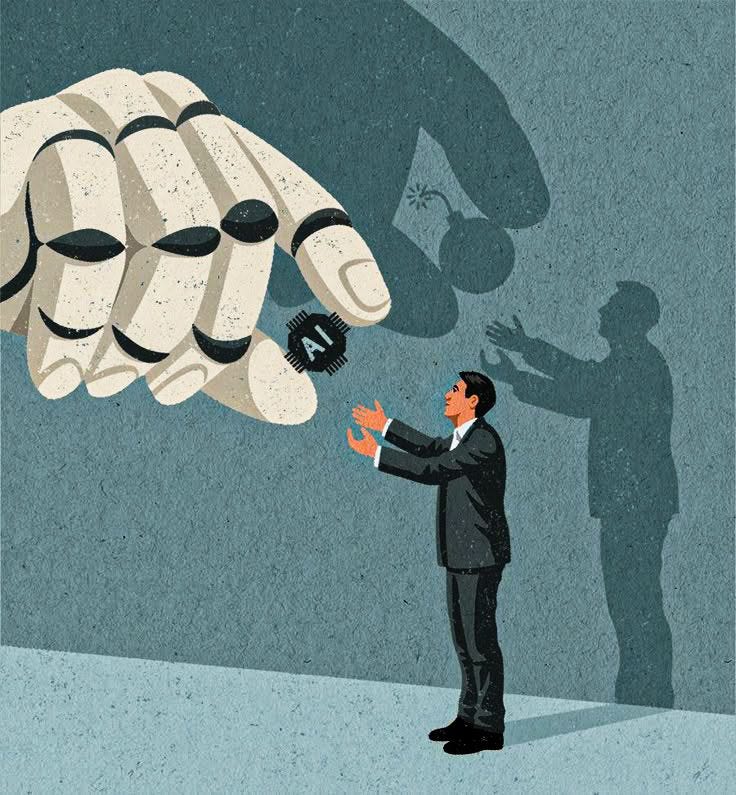
Your feed is probably divided into two camps:
The first says “Tech is dead. AI will take the jobs. Learn plumbing.” The second says “I built a SaaS with AI in ten days and hit $10K MRR. You can too.”

Here is what the data actually says:
- Global hiring remains roughly 20% below pre-pandemic levels, according to LinkedIn.
- The World Economic Forum expects 92 million jobs to be displaced by 2030, but also projects 170 million new roles.
- India entered 2026 with tech openings down 24% year over year and nearly 60% below its 2022 peak.
- AI was cited in more than 100,000 US job-cut announcements during the first half of 2026.
- At the same time, LinkedIn says more than 1.3 million AI-enabled jobs have emerged globally over the past two years.
- Solo-founded startups are becoming more common, but the median outcome looks nothing like the screenshots on X.
The technology market is not dead. It is being repriced around a different unit of value. Writing code is getting cheaper. Owning outcomes is getting more valuable. That is the third truth nobody can package into a 30-day course.
Part One: The Global Tech Slowdown Is Real
Let us begin with the bad news, because refusing to acknowledge it is another form of hype.
LinkedIn’s 2026 global labour-market analysis found that hiring remains approximately 20% below pre-pandemic levels. Job seekers are outnumbering openings by the widest margin since the pandemic, while job transitions have fallen to a decade low.
This is not only an American problem; it is not only an Indian problem. Hiring conditions vary by country, but the pressure appears across major technology markets. The United States and United Kingdom have recently shown signs of recovery in software-engineering vacancies. Canada has been relatively flat. Germany and France have remained more cautious.
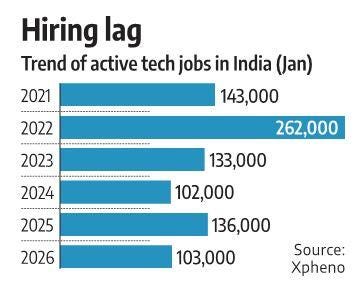
India provides one of the clearest examples of the contraction. India had approximately 103,000 active technology openings at the beginning of the year.
That was:
- Down 24% from January 2025
- The second-lowest January level since 2021
- Almost 60% below the 262,000 openings recorded in January 2022
At the 2022 peak, technology represented roughly 85% of active hiring demand tracked in the report. By January 2026, its share had fallen to around 52%.
Kamal Karanth, co-founder of Xpheno, described it bluntly:
The Indian tech sector, which once dominated the country’s overall talent action, seems to have caught a cold in late 2022 and continues to struggle with a low-to-no recovery trajectory.
The details differ by country. The direction does NOT!
The post-pandemic hiring boom ended; capital became more expensive. Companies corrected years of overhiring. AI then gave executives another reason to reconsider how many people they needed and which people they wanted to keep.
The Layoffs Are Real Too
US employers announced 443,604 job cuts during the first half of 2026. Technology companies accounted for 139,156 cuts, up 83% from the same period in 2025. AI was cited in 101,743 announced cuts, or approximately 23% of the total.
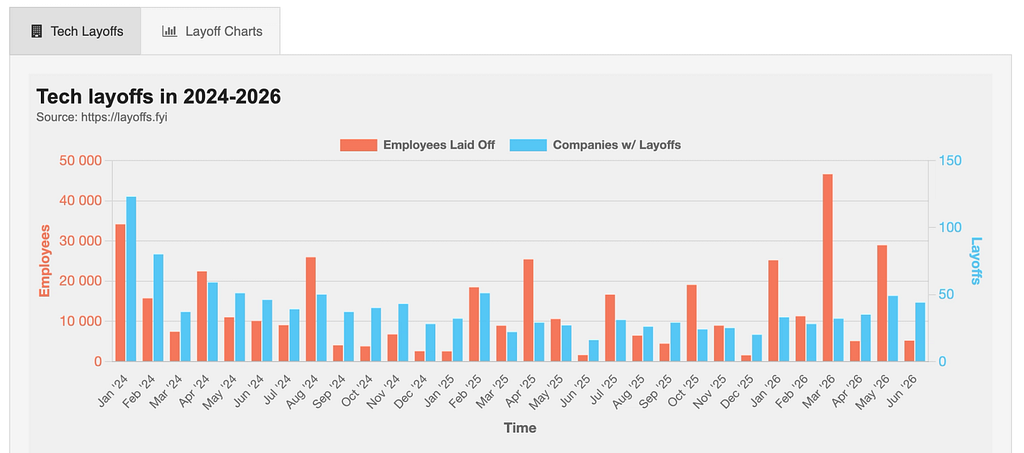
Globally, media trackers have documented cuts across the United States, India, Europe and Asia. But there is an important distinction
A company citing AI during a layoff does not prove AI directly replaced every affected employee.
“AI transformation” can describe several things at once:
- Automating repetitive work
- Flattening management layers
- Redirecting budgets toward AI infrastructure
- Correcting pandemic-era overhiring
- Consolidating products
- Using AI as a convenient explanation for cost-cutting
The layoffs are real; the exact causal role of AI is harder to measure, but that nuance rarely survives a viral post.
The Global Forecast Is Disruption, Not Extinction
The World Economic Forum surveyed more than 1,000 companies representing over 14 million workers.
Its projection for 2030 is not subtle:
- 170 million jobs created
- 92 million jobs displaced
- 78 million net new jobs
- Approximately 22% of current formal employment disrupted
That is not “nothing will change.” It is also not “there will be no jobs.” The report found that 41% of employers expect to reduce headcount where AI can automate tasks.
At the same time:
- 77% plan to upskill workers
- Roughly half expect to move affected employees into other roles
- Two-thirds plan to hire people with specific AI skills
- AI, big data and cybersecurity rank among the fastest-growing skill categories
The correct global story is not mass DISAPPEARANCE; it is mass REALLOCATION.
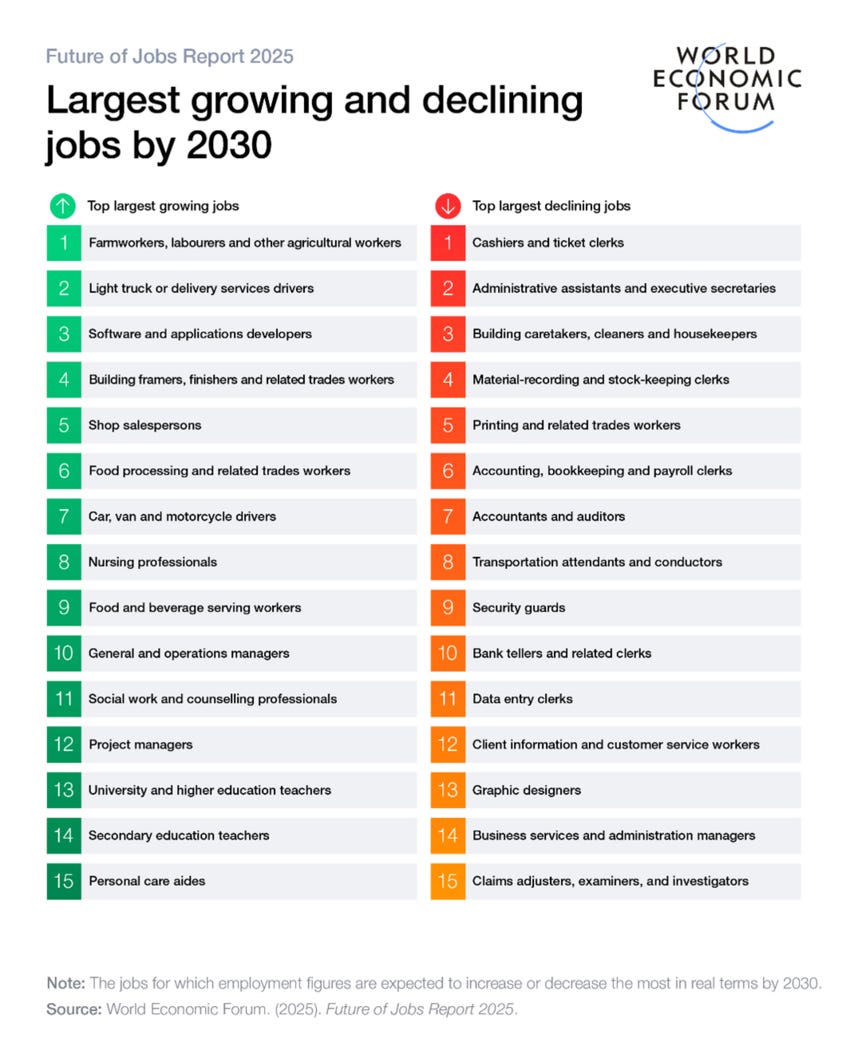
That may be little comfort if your current role sits on the wrong side of the shift, but net job creation does not guarantee that displaced workers will move easily into the new jobs. A junior developer cannot become an AI platform engineer overnight, and also a content moderator cannot instantly become a cybersecurity specialist.
New jobs and displaced workers may exist in different countries, require different skills and appear at different times, but the transition can be painful even if the final global number is positive.
The Market Did Not Die. It Split in Two.
While broad technology hiring remains weak, demand for AI-orientated work is growing rapidly. LinkedIn says more than 1.3 million AI-enabled jobs have emerged globally over the past two years.
These include roles such as:
- AI Engineer
- Forward-Deployed Engineer
- Machine Learning Engineer
- Data Annotator
- AI Product Manager
- AI Governance Specialist
- MLOps Engineer
- AI Security Engineer
Companies with a “Head of AI” role increased across multiple economies during the past year:
- Australia: 32%
- Canada: 31%
- India: 30%
- Germany: 30%
- United Kingdom: 30%
- United States: 28%
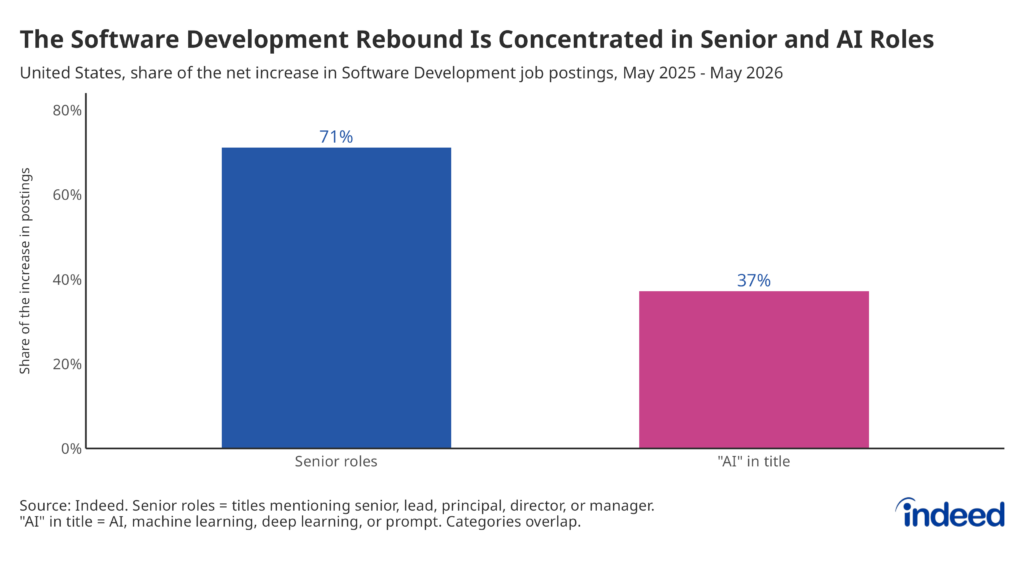
The software market itself shows the same split; US software-development postings increased nearly 15% between February 2025 and May 2026.
But the rebound was highly concentrated:
- 71% of the increase came from senior roles
- 37% came from jobs mentioning AI in the title
The old market rewarded people who could produce code. The new market increasingly rewards people who can decide what should be built, coordinate AI systems, verify the output and remain accountable when it fails. That is a much smaller talent pool.
AI Fluency Matters — but “Learn AI” Is Terrible Career Advice
At Carnegie Mellon’s commencement on May 10, 2026, NVIDIA CEO Jensen Huang told graduates:
“AI is not likely to replace you, but someone using AI better than you might.”
https://medium.com/media/322aab8cf28e8ee5f9ee4a332b4cbd00/href
That line is useful… It is also frequently oversimplified! “Using AI better” does not mean generating more code.
It means knowing:
- What should be automated
- What must remain under human review
- How to specify a task clearly
- How to evaluate model output
- How to detect plausible but incorrect answers
- How to control permissions and data access
- How to measure cost, latency and reliability
- How to debug the entire system
- When AI is slower than doing the task manually
The 2025 Stack Overflow Developer Survey captured the contradiction perfectly. Approximately 84% of developers used or planned to use AI tools, but only 33% trusted their accuracy.
More developers actively distrusted AI output than trusted it, but the most experienced developers were also the most sceptical; that is not resistance to progress, but it is what accountability looks like.
AI Does Not Automatically Make Developers Faster
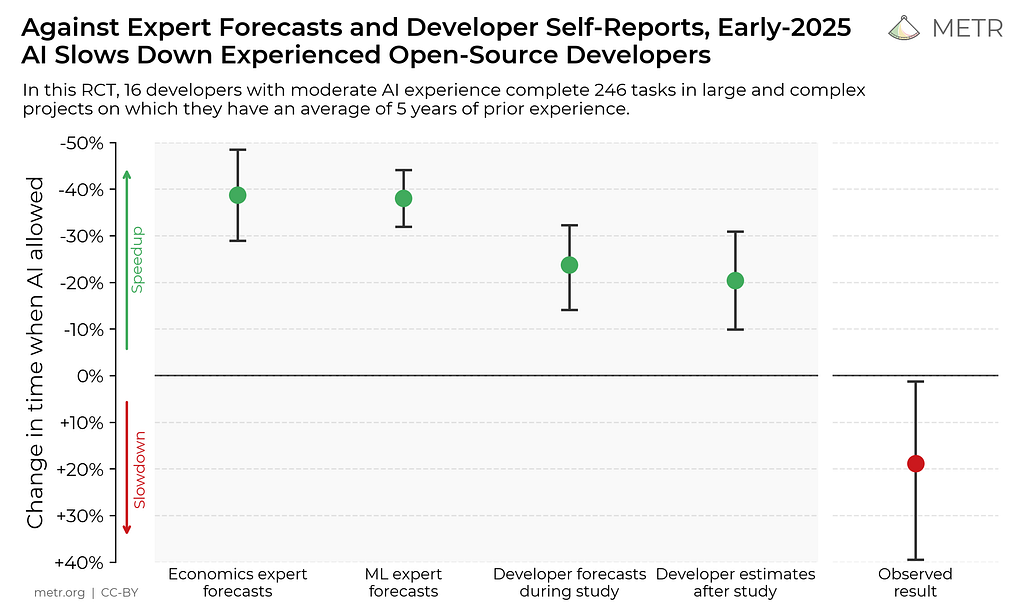
A randomised METR study produced an uncomfortable result. Sixteen experienced open-source developers completed 246 real tasks in repositories they already knew. Before the study, they predicted AI would make them 24% faster. Afterward, they believed it had made them 20% faster. In reality, they took 19% longer when using early-2025 AI tools.
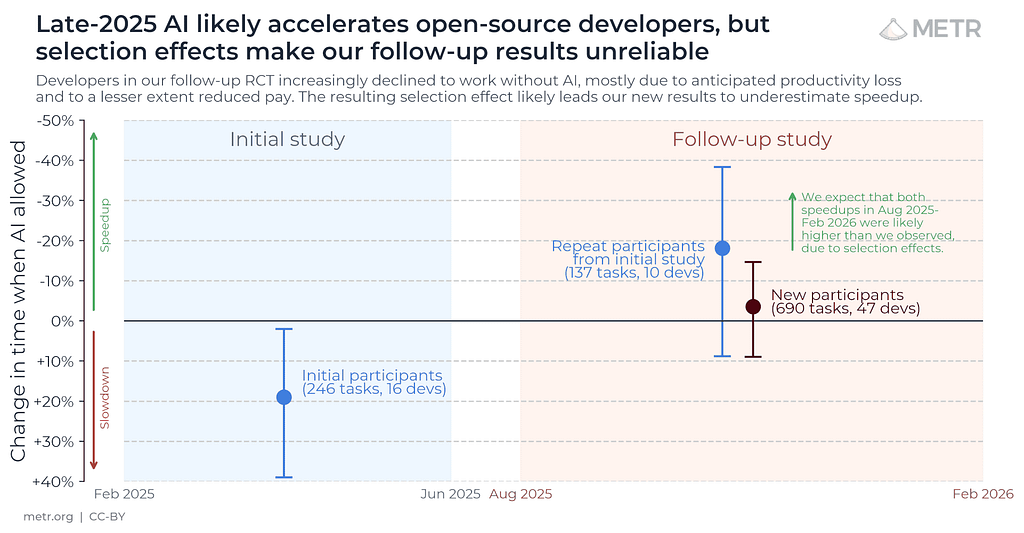
found signs that newer agentic systems may improve productivity. But selection effects and changing developer workflows made the results too unreliable for a confident estimate.
AI productivity depends on the developer, the task, the codebase and the engineering controls surrounding the model.
AI can accelerate a strong engineering system, but it can also accelerate technical debt, security failures and architectural confusion.
Vibe Coding Already Evolved Into Something Harder
Andrej Karpathy coined “VIBE CODING” in February 2025, and One year later, he proposed a more serious term, “AGENTIC ENGINEERING”
Agentic, because the new default is that you are not writing the code directly 99% of the time, you are orchestrating agents who do and acting as oversight. Engineering, to emphasize that there is an art and science and expertise to it.
The important word is not “agentic”; it is “engineering”, as vibe coding raises the floor. It lets more people turn an idea into a prototype, whereas agentic engineering raises the ceiling as it requires someone to preserve correctness, security, maintainability and product judgement while fallible agents produce the implementation.
The valuable engineer of 2026 is not necessarily the person typing fastest; rather, it is the person who can turn ambiguous intent into a reliable deployed system.
Part Two: The Solopreneur Boom Is Real. The Screenshots Are Misleading.
The Global Entrepreneurship Monitor’s 2025/2026 report surveyed more than 160,000 people across 53 economies representing approximately 57% of global GDP. It found record or near-record startup activity in many regions. But it also found serious weaknesses in long-term sustainability because fear of failure still prevents roughly TWO in FIVE adults from starting a business.
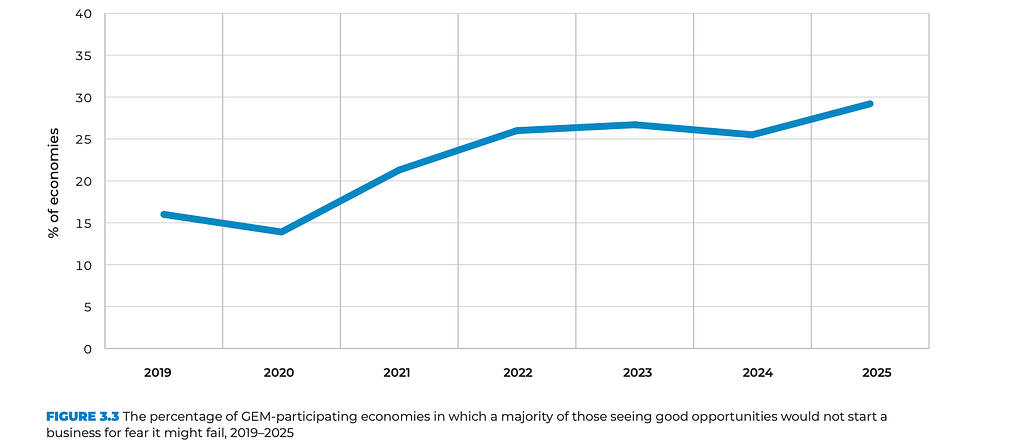
AI has reduced the cost of launching BUT it has NOT eliminated risk, as the strongest available solo-business datasets remain concentrated in the United States, so they should not be presented as universal global averages.
Still, they show the direction of travel.
The US Census Bureau counted 30.4 million nonemployer businesses in 2023. Together, they generated nearly $1.8 trillion in receipts.
Carta found that the share of new US startups with a solo founder increased from 23.7% in 2019 to 36.3% in the first half of 2025, that sounds like proof that the one-person company has arrived, but look closer: “nonemployer business” does not mean “profitable SaaS founder”
- A consultant
- A freelancer
- A part-time seller
- A partnership with no employees
- A small corporation
- A side business with minimal revenue
- A profitable one-person software company
The $1.8 trillion figure represents gross receipts, not founder income or profit.
Carta’s data also shows that while solo founders represented 30% of startups founded in 2024, they received only 14.7% of the cash raised through priced equity rounds.
Formation is up. Guaranteed success is not. AI reduced the cost of attempting a startup. It did not change the fact that most attempts fail to become meaningful businesses.
What Real Solopreneurs Actually Sell
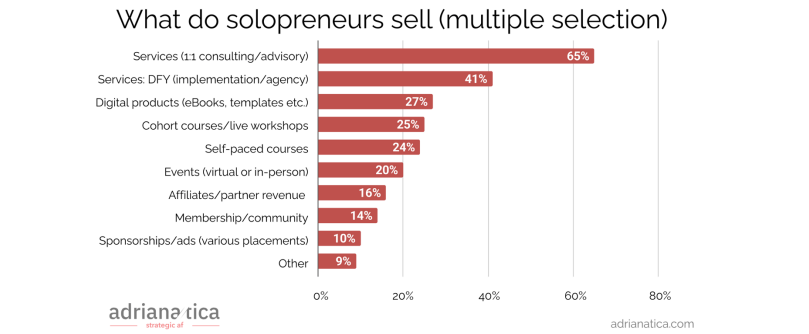
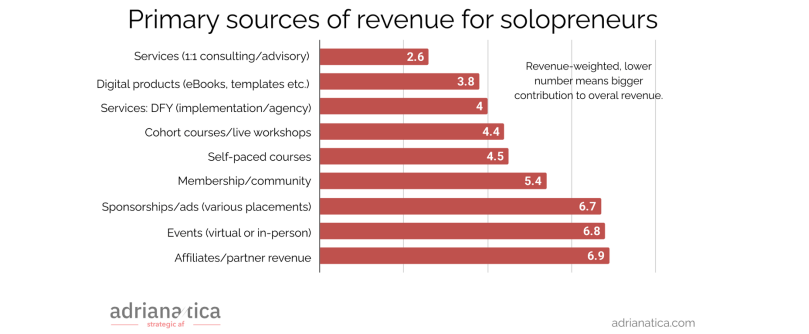
Marketing strategist Adriana Tica surveyed 153 solo operators and small founder-led teams for her State of Solopreneurship 2026 report; the sample is not globally representative, as it is self-reported, mostly B2B and concentrated in North America and Europe.
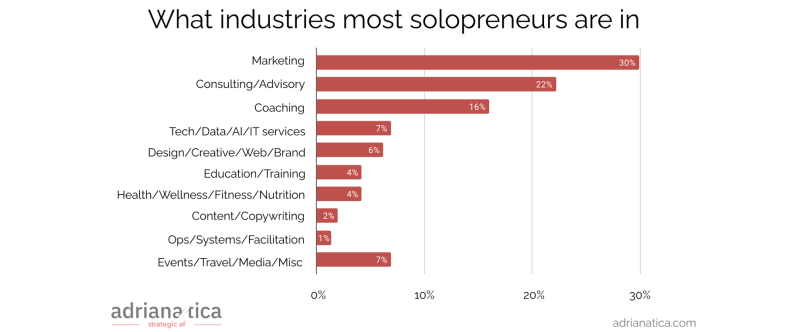
But its findings are more useful than another viral revenue screenshot:
- Only 33% reported earning more than $100,000 annually
- Six-figure revenue appeared more consistently after the third year
- Services, consulting, audits, retainers and done-for-you work generated more revenue than courses or digital products
- LinkedIn and email were the channels respondents most planned to increase
- AI was primarily a productivity tool, not a business model
That last point deserves to be printed above every AI founder’s desk:
AI is a tool. It is not a business model.
Customers do not pay because your product uses an agent, but they pay because it saves money, generates revenue, reduces risk or removes work they hate. “AI-powered productivity platform” is not positioning. “An AI-assisted documentation system for therapists that reduces administrative work while preserving patient privacy” is positioning.
Specificity creates value, as the model is just an implementation detail.
The Tweet Is Often the Product
When someone posts:
I built a SaaS in ten days and reached $10K MRR in a month
Ask five questions: 1. Is that revenue collected, recurring and net of refunds? 2. Did the founder already have an audience? 3. How much came from a temporary launch spike? 4. What was the acquisition cost? 5. What else is the founder selling?
Sometimes the business is real; sometimes the founder spent five years building distribution before the “OVERNIGHT” launch, and sometimes the revenue is annualised from a single good week, and sometimes the SaaS is a prop used to sell templates, courses, sponsorships or consulting.
The screenshot shows the winner, but it does not show the thousands of people who copied the same playbook, shipped the same wrapper and received no users, as that is survivorship bias with a checkout page.
Building Became Global. Distribution Is Still Local.
AI tools made it possible to build software from almost anywhere, as a developer in Bengaluru, Lagos, Warsaw, São Paulo or Jakarta can access many of the same models and deployment platforms as a founder in San Francisco.
That is historically significant, as it also means the supply of software has exploded globally, and when everyone can build, building alone stops being differentiation.
- Distribution
- Domain expertise
- Credibility
- Customer access
- Regulation
- Language
- Local market knowledge
- Trust
This is why the strongest opportunities are often specific rather than universal.
NOT an AI productivity app for everyone BUT a multilingual compliance assistant for small exporters dealing with European documentation
NOT an AI sales agent BUT a lead-qualification workflow for independent commercial insurance brokers in the UK
The more globally accessible the technology becomes, the more valuable local context becomes.
The Third Truth: Employment and Entrepreneurship Are Not Opposite Bets
The internet frames the decision like this Keep your job and remain trapped OR Quit, bet on yourself and become free
That is emotionally compelling and financially reckless, as for most people, the better strategy is a barbell:
- Build a career in a category with growing demand
- Use the income and experience from that career to fund small entrepreneurial experiments
A salary provides more than money; it provides runway, access to real problems, exposure to operating systems and the ability to make patient decisions. Financial desperation corrupts product judgement, as when rent depends on next month’s launch, every weak signal looks like product-market fit.
When you have runway, you can kill bad ideas before they consume years; the job and the side project are not competing identities; rather, they are complementary risk positions.
If You Want a Tech Job, Stop Choosing “Frontend vs Backend” Like It Is 2018
Frontend and backend engineering are NOT DEAD, as they are foundational layers. The mistake is treating a framework as a complete professional identity.
React is not dead
But “I know React” is no longer enough differentiation when AI can generate a respectable interface in minutes so the roles gaining leverage are closer to production outcomes.
AI Deployment Engineer
Integrates models into real applications; learns model APIs, structured outputs, retrieval, caching, model routing, cost controls and evaluation.
Agentic Systems Engineer
Designs workflows in which agents plan, call tools, exchange state and operate under supervision. The hard problems are permissions, recovery, memory, observability and deciding when autonomy should stop.
AI Platform or MLOps Engineer
Builds the infrastructure used to deploy and monitor models safely. Think inference infrastructure, Kubernetes, tracing, model registries, GPU orchestration, CI/CD and reliability.
AI Security and Governance Engineer
Handles prompt injection, data leakage, tool abuse, model supply-chain risk, access control, auditability and compliance. AI security is not traditional app security with a chatbot added. Agents create new trust boundaries because they can read data, make decisions and invoke tools.
Forward-Deployed Engineer
Works directly with customers to turn an ambiguous business problem into a deployed system. This role sits between engineering, consulting and product management. Listings for forward-deployed engineers reportedly increased more than 700% between April 2025 and April 2026.
Data, Retrieval and Evaluation Engineer
Builds the systems that determine what an AI application knows and whether its answers are good enough. That includes data pipelines, retrieval quality, benchmark design, human evaluation, regression testing and production feedback loops.
The pattern is consistent:
Companies are hiring people who can connect AI to a real workflow and remain accountable for the result.
Not people who can produce the largest number of generated files.
A Better Portfolio for the Global 2026 Job Market
Do not build another generic chat interface but build one production-shaped project for one narrow domain.
For example: a support-ticket triage system for a small SaaS company that classifies requests, retrieves policy documents, drafts responses and escalates uncertain cases to a human.
Then demonstrate:
- A written problem statement
- A real user or realistic workflow
- Authentication and permissions
- Retrieval with citations
- Evaluation data
- Cost and latency measurements
- Prompt-injection defenses
- Logging and observability
- Human approval for risky actions
- Failure cases and trade-offs
- Deployment instructions
- A postmortem explaining what did not work
The README is not decoration; it is evidence that you can reason about a system rather than merely generate one. One credible, deployed project with users is worth more than ten tutorial clones.
A Better Solopreneur Plan
If you want to build a one-person business, use a plan that survives contact with reality.
1. Keep your income
Do not create artificial urgency by quitting too early but build a runway before you need it.
2. Start with a painful niche
Avoid “for everyone”. Pick a group you can reach and a problem with an existing budget.
3. Sell the service before automating it
Manual delivery teaches you what the customer values, as it also reveals which work should never be automated.
4. Build distribution before infrastructure
Talk to users, publish useful work, collect emails, and join communities. Do not spend four months designing a multi-agent architecture for a product nobody requested.
5. Use geography as an advantage
Local regulation, language, payment systems and business practices can become a moat, but do not assume every successful product must begin in the United States.
6. Measure collected revenue, retention and usage
7. Plan for years, not launch week
The available evidence suggests that meaningful, consistent solo-business revenue usually takes years. Use 12–36 months, not 30 days, as your mental timeline.
8. Let AI reduce cost — not standards
Use agents for research, implementation, testing, operations and support. Keep responsibility for security, accuracy, customer trust and product direction.
What I Would Tell a Friend Over Coffee
I run side projects; I have also built a streetwear brand. Also, I work with brands as their tech partner. I contribute to open-source projects. I write and publish content as well. I do all of it while working a full-time job. That is not a lack of conviction, but rather it is risk management.
If a friend asked whether 2026 is a good time to enter technology, my answer would be IT IS ONE OF THE BEST TIMES IN HISTORY to build something, but it is also one of the worst recent times to expect a comfortable, interchangeable technology job.
Those statements are not contradictory, as the cost of creating software collapsed, and the bar for being worth hiring or paying rose.
So if your plan is to grind interview questions, submit 200 identical applications and wait for a large offer, that path has become narrower across much of the world.
If your plan is to understand a real problem, use AI to build a reliable solution and own the result, the opportunity may be larger than ever, as the market no longer rewards the same things evenly.
Why I Still Build Without Expecting a Cheque
I pay for my tools myself, and my open-source work is free. It is not an investment opportunity; rather, it is an investment in my own capability, as I did not start building when AI made it fashionable.
I started in sixth standard with an HTML summer assignment, and since then, I have kept building things, breaking them and trying to understand what is inside.
The streetwear brand covers the creative side. The technical projects cover the part of me that needs to understand how new systems work.
Not everything needs to become a startup
Not every repository needs an MRR screenshot, as sometimes the return is taste, judgement, reputation or the ability to solve a problem you could not solve last year, and yeah, that still compounds.
If you are building only for fast money, this path will probably disappoint you, as if you would keep building even if nobody applauded, you would have the one advantage that cannot be purchased through a course: You can stay in the game longer than the hype cycle…
The Earned Optimism
There has never been a moment when one person with a laptop could produce this much.
A solo builder can create a brand, ship a desktop application, automate operations, produce media and deploy infrastructure using tools that would have required an entire team a decade ago, and that opportunity is no longer limited to one city or one country, so that is extraordinary. But the bar to stand out increased at exactly the same time.
When everyone can produce a landing page, landing pages have little value. Also, when everyone can clone a SaaS, clones have little value. When everyone can generate code, generated code is not the moat.
The moat is
- Choosing the right problem
- Understanding the user
- Exercising technical judgment
- Building trust
- Distributing consistently
- Applying local knowledge
- Staying long enough to learn what everyone else misses
Karpathy described the human contribution to agentic engineering as
High-level direction, judgment and taste.
Those are not soft extras; they are the scarce inputs. The doomers want you to believe the floor has disappeared AND The hype merchants want you to believe the ceiling is unlimited, but the more accurate picture is that the floor moved, the ceiling rose and the staircase became steeper.
Some people will look back at this period the way early mobile developers look back at 2012, but they will not be the people who believed every viral screenshot, but they will be the people who learnt to build reliable systems, found a specific audience and kept going after the feed moved on.
Two Questions Worth Answering
First: What is the biggest gap between what your feed says is happening and what is actually happening in your country, company or career?
Second: What evidence would change your mind?
For me, one useful signal would be median full-time solopreneur income – not aggregate business revenue – rising materially across several countries for multiple consecutive years. Another would be entry-level hiring recovering while AI exposure continues to increase, as that would weaken the strongest displacement argument.
Pick your own falsifiable signal. Otherwise, you are not evaluating evidence; you are defending a camp. The era of trusting the loudest person on the timeline should be over because the data is available, so go look at it.
And you will probably end up somewhere between doom and hype, and that is where you want to be