When the tech world woke up to the news that Peter Steinberger, the creator of the open-source AI agent OpenClaw, is joining OpenAI, the reactions ranged from “doom day for the project” to “a massive upgrade for the ecosystem.”
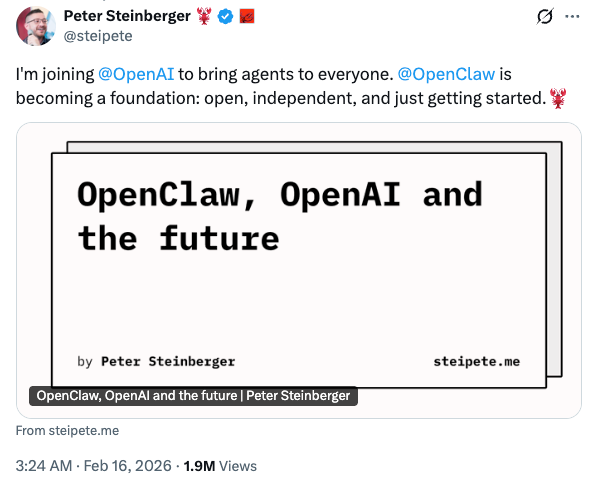
There was intense speculation that both Meta and OpenAI were positioning themselves around the project, but what finally surfaced was confirmation that Steinberger is joining OpenAI to lead development on the next generation of personal and autonomous agents and that OpenClaw will be transitioned into an open, independent foundation with continued open-source support.
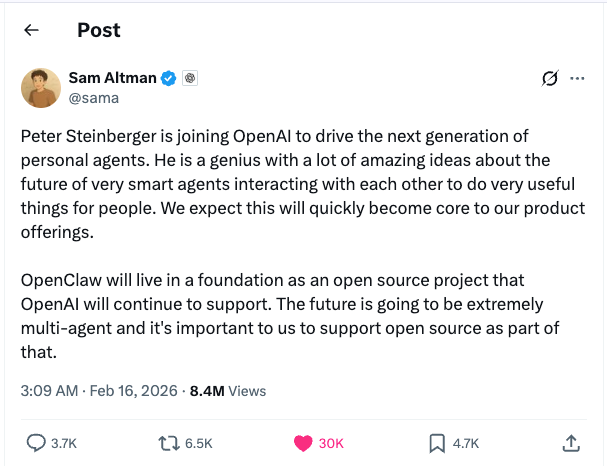
Sam Altman publicly framed this as a commitment to broader agentic innovation, not a closure of the original work.
Steinberger himself wrote on his own blog that it was critical to him that OpenClaw remains open and independent, and that joining OpenAI was the fastest way to bring his vision to scale.
He said: “It’s always been important to me that OpenClaw stays open source and given the freedom to flourish… ultimately, I felt OpenAI was the best place to continue pushing on my vision and expand its reach.”
OpenClaw, OpenAI and the future | Peter Steinberger
That statement alone should ground many narratives: t_his was not a stealth acquisition where the project disappears behind corporate walls_. It’s very public support, with the original creator still championing openness even while aligning with one of the biggest players in AI today.
How This Shift Matters for Builders and Developers
If you’ve been using OpenClaw, experimenting with agents that run locally or in the cloud, and imagining what “always-on” AI assistants could help you automate, this moment is significant in a few ways.
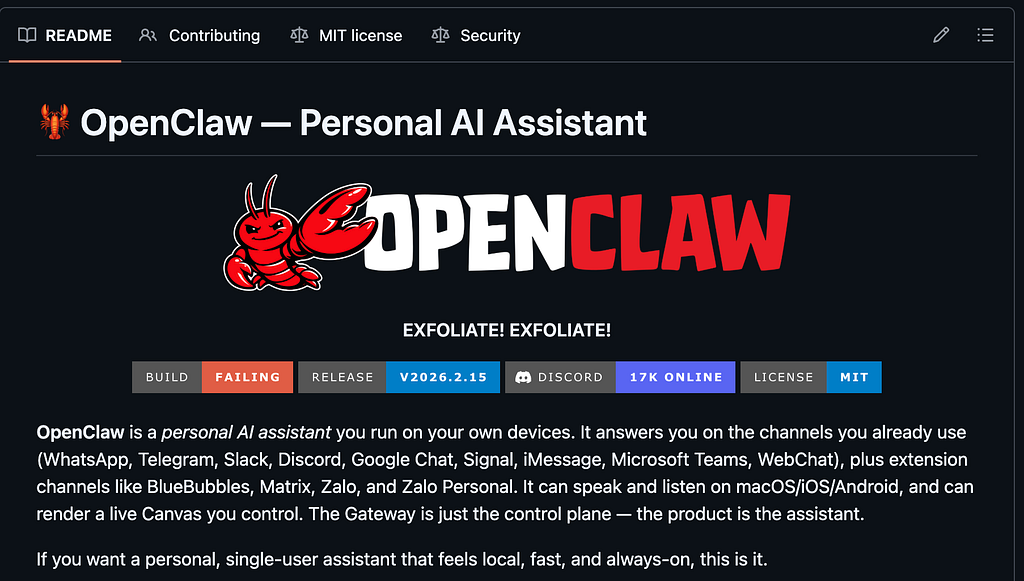
**First… legitimacy at scale. **Now that OpenClaw’s creator is embedded within OpenAI’s agent team, the project has visibility and infrastructure behind it that few individual open-source tools ever get. OpenAI’s official posture is that OpenClaw will live on as an open-source foundation that is supported rather than absorbed and closed.
**Second… continuity with openness. **Despite trade rumors and tech coverage speculating about deal competition, the official messaging from both Steinberger and OpenAI emphasizes openness and community support not a hidden acquisition. That continuity matters if you’ve invested time in the ecosystem and are worried about the codebase disappearing or being locked behind proprietary layers.
**Third… integration potential. **OpenClaw’s strengths — autonomous workflows, persistent state, multi-service automation — now sit alongside OpenAI’s widely deployed models and infrastructure. Imagine bringing the best of locally runnable agents with deep integration points together with globally scaled AI models… now that’s a toolkit no single solo project could match on its own.
In short, this move doesn’t dilute OpenClaw’s identity. It amplifies it with resources and reach while keeping the developer ethos intact.
Technical Predictions: What This Means for Integrations, Toolchains, and Developer Workflows (2026–2027)
As someone who has been on the ground with OpenClaw, the real excitement is not just its current capabilities… but where this alignment with OpenAI could steer the agentic landscape.
1. Deeper multi-agent orchestration capabilities: With Steinberger focused on personal agents at OpenAI, expect frameworks that make it easier to coordinate multiple autonomous agents not just one isolated instance running alone. That means agent teams that can share memory, task queues, and goals, enabling modular agent networks that can work together on complex goals without heavy orchestration code from developers.
2. Standardized agent runtimes and toolchains: Right now, building an agent that integrates messaging, system access, cloud hosting, and persistence is a do it yourself stack. With OpenAI’s backing, we’ll likely see standardized agent runtimes, SDKs, and plugin architectures that make extending and deploying agents easier, safer, and interoperable across platforms.
3. Secure data pipelines and sandboxing: Running autonomous agents with access to email, calendars, and messaging is powerful… and risky if misconfigured. That is now a hard engineering priority. Expect new patterns and APIs that deeply sandbox agent access, isolate execution contexts, and provide fine-grained permissioning around sensitive data — the kind of tooling that makes agentic workflows viable for enterprise and consumer use without opening security holes.
4. Agent-first workflows for everyday tooling: Instead of “build a script, then build a UI”, workflows could evolve where agents are primary interfaces. Your code editor, terminal, cloud dashboard, and collaboration platforms may soon be agent-ready by default, meaning extensions and automation are first-class citizens instead of afterthoughts.
5. Hybrid local/cloud deployment models: One of OpenClaw’s original innovations was that local agent execution could be as powerful as cloud-driven automation. With OpenAI’s involvement, hybrid models where local agents maintain personal context while offloading heavy reasoning to cloud models could become mainstream.
All of this suggests a world where agentic development is not a fringe experiment !! but a core part of modern software engineering workflows in 2026–2027, blending autonomy, scalability, and personalized computing.
In the End… What Are We Really Building Toward?
This whole episode from OpenClaw’s viral rise… to the public hiring announcement and the commitment to keep its openness alive challenges us to think bigger.
Are we building tools that perform tasks… or ecosystems that empower creators to build autonomously acting systems?
Not just software that writes code for us. Not just automation that runs once. Not just interfaces that respond.
But systems that think, adapt, collaborate, and grow with us over time.
And here’s the deeper question lingering as we witness this shift:
When autonomous agents become an extension of ourselves not just tools but collaborators how will we define ownership, trust, and agency in the systems we help create?
Because that is the frontier we are stepping into together…